Two Cairns StudioPyramid Field Notes

Exploring the building process

How were the
pyramids built?

The answer becomes easier to follow when we break the work into separate questions: where the stone came from, how it travelled, how it was hauled and how it was finally lifted and placed.

These five sources bring together evidence relevant to Giza, a controlled hauling experiment and a comparison from Hatnub. They help investigate separate parts of the problem, but do not establish a complete construction sequence. Choose a question below to see the relevant sources and what they can tell us.

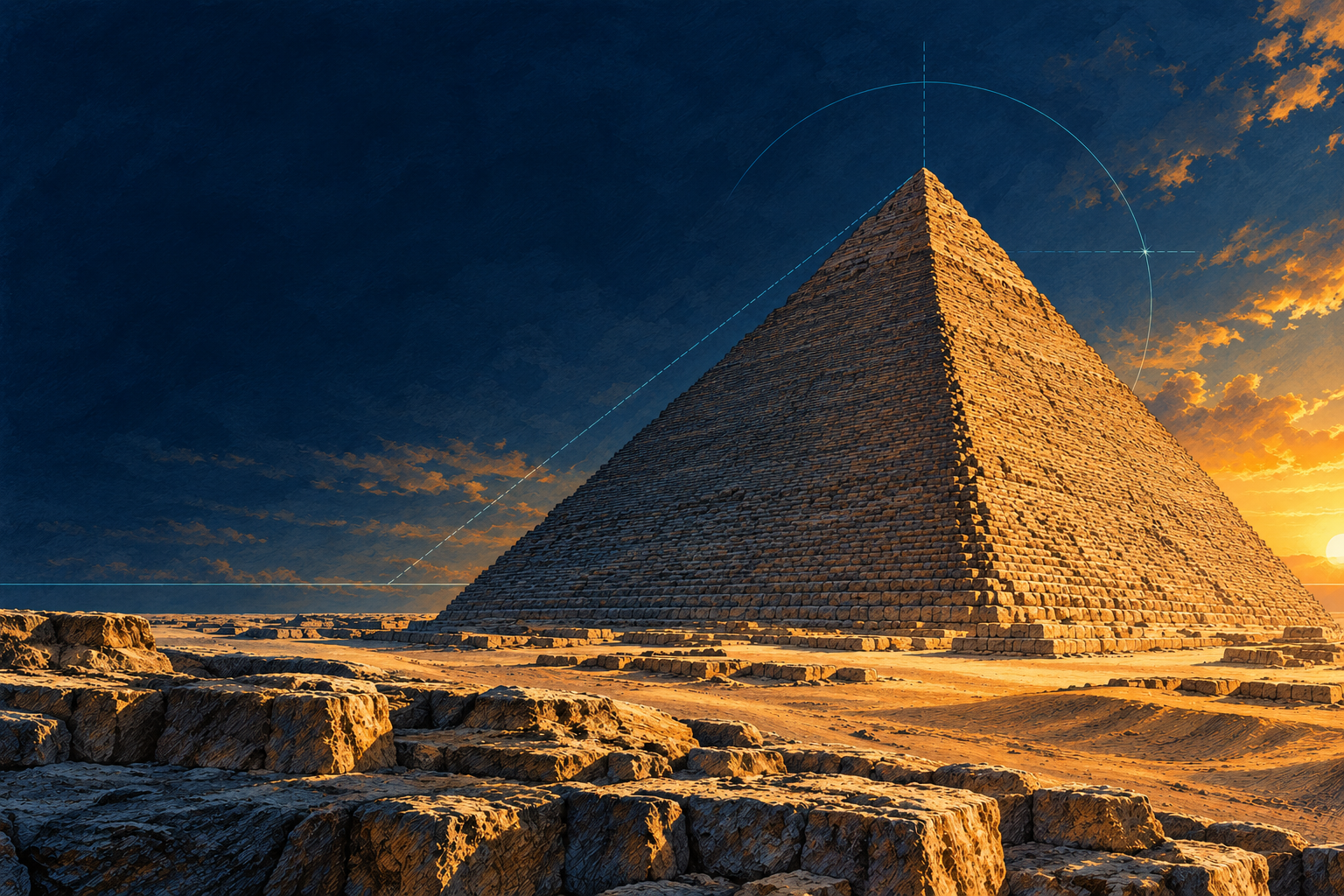
An illustration of the Great Pyramid, created for this site rather than from a measured reconstruction.

This is an AI-generated illustration. It is not a photograph or a reconstruction of a measured building method.

Start with a question

Which part would you like to explore?

Choose a stage to see what the sources tell us and which questions they leave open.

Where did the stone come from?

Quarry traces near the Great Pyramid support a nearby source for much of the core limestone. Merer’s diary records stone-loaded boat journeys from Tura to Khufu’s pyramid project.

Where the evidence stops

These sources help us understand supplies and delivery. They do not account for every block or explain how the stone was lifted and placed.

2 relevant sources · S5 + S1

Read the supporting sources

Follow the journey of the stone.

A way to organise the questions, rather than a proposed building method.

Knowing where a material came from is valuable, but it does not explain how it was lifted. Keeping these steps separate helps us avoid asking a source to prove something it never records.

Read the original work

What do the sources
actually tell us?

Choose two sources to compare what they explain.

Each note sets out the finding, what it leaves unanswered and where to check the relevant passage. The source numbers are there to make it easy to trace a statement back to the original work.

S1 · Contemporary record / modern edition

Merer’s cargo diary

2017 edition · Old Kingdom record

What it tells us
The diary records stone-loaded boat journeys from Tura through named stops to Akhet-Khufu, the pyramid project.
What it leaves unanswered
The editor identifies fine limestone; casing use is a probable interpretation. The diary does not record construction techniques or explain every block.
Where to check it
Papyrus B: BI 26–27 and BII 5–6, linked PDF p. 6; editor’s summary, printed p. 151 / PDF p. 7.

S2 · Controlled laboratory experiment

Wet sand and sled friction

29 April 2014

What it tells us
A small PVC sled pulled over three prepared sands showed lower force under appropriate wetting conditions. Too much water could increase resistance.
What it leaves unanswered
The reported force reductions are experiment-specific. They do not measure ancient labour savings, full-size hauling, ramps or block placement.
Where to check it
Fall et al., Physical Review Letters 112, 175502: p. 175502-1, methods; Fig. 2; p. 175502-4, conclusion. DOI: 10.1103/PhysRevLett.112.175502.

S3 · Landscape reconstruction / interpretation

The Ahramat river branch

16 May 2024

What it tells us
Satellite and topographic work, an approximately 1.2 km geophysical profile and two sediment cores support reconstruction of parts of a former branch extending roughly 64 km.
What it leaves unanswered
Pyramid, causeway and valley-temple alignments support the authors’ water-transport interpretation. They are not direct observations of cargo journeys or lifting methods.
Where to check it
Ghoneim et al., Communications Earth & Environment 5, 233: Results, position/morphology (Fig. 1); subsurface/sedimentology (Figs. 2–3); Discussion. DOI: 10.1038/s43247-024-01379-7.

S4 · Physical traces / proposed mechanism

Hatnub’s quarry hauling route

2018 excavation report

What it tells us
The Hatnub calcite-alabaster quarry preserves a central route, flanking steps, postholes and wall notches. Inscriptions and tool marks place the hauling system no later than Khufu.
What it leaves unanswered
Ropes, posts and descending teams form a reconstruction of its operation. This is a different quarry and material; adaptation to Giza does not establish its ramps or a complete placement sequence.
Where to check it
IFAO report, section 17134, Hatnoub; printed pp. 196–201 / PDF pp. 205–210, especially printed pp. 197–199. Gourdon and Enmarch campaign.

S5 · Archaeological traces / project account

The Great Pyramid quarry

AERA project account · 2009

What it tells us
Quarry channels and lever sockets are observed near the pyramid. Proximity and an approximate volume comparison support a nearby source for core limestone.
What it leaves unanswered
The account’s suggested ramp debris is speculative. Quarry traces do not establish the whole lifting sequence; Tura should not be treated as the source of every block.
Where to check it
AERA, “The Great Pyramid Quarry”: quarry channels, lever sockets and volume comparison sections.

The proposed rope-and-post system at Hatnub and the interpretation of the former Ahramat river branch are reconstructions drawn from physical evidence. The wet-sand finding comes from a controlled laboratory experiment. These distinctions matter when deciding what we can say about construction at Giza.

See the dates, access details and reuse notes for every source